Every product is independently selected. Things you buy through our links may earn us a commission.
Weeds in driveway cracks and patio joints are a different problem from weeds growing inside your lawn. The best weed killer for driveways is usually a nonselective herbicide applied only to hard surfaces, not a grass-safe lawn treatment sprayed broadly across the property. The winning strategy is simple: identify the target, choose the correct label, control the spray, and protect every plant you want to keep.
That last part matters. Nonselective herbicides kill any plant they contact, including turfgrass, flowers, vegetables, shrubs, and young trees. Used with discipline, they clear hardscape weeds without turning your lawn edge into a brown border.
1. Start With The Right Target
Driveways, patios, sidewalks, and paver joints are non-crop areas where the goal is to remove all unwanted vegetation. A nonselective herbicide fits that job because it is designed to kill grasses and broadleaf weeds rather than preserve them.
A lawn is the opposite situation. When weeds are scattered through established turf, you need a product specifically labeled for selective lawn use and for your grass species. A driveway-safe product is not automatically grass-safe, and a grass-safe product is not automatically labeled for concrete, pavers, or gravel.
Do not try to solve both problems with one blanket application. Treat hardscape weeds as spot treatments, then manage lawn weeds with mowing, watering, fertilization, and a separate turf-labeled plan.
2. Choose The Correct Roundup Format
The approved Green Thumb product list includes a Roundup concentrate refill. Before mixing anything, read the exact product name and label on your container. Roundup sells multiple concentrate and ready-to-use formats, and their rates, active ingredients, application sites, and restrictions are not interchangeable.
A true concentrate is diluted with water in a compatible sprayer. A ready-to-use refill is applied as packaged and must not be diluted unless the label specifically says otherwise. Concentrate generally delivers better value across repeated driveway and patio treatments because one container makes multiple gallons of spray solution, but that value depends on accurate measuring.
The Roundup Weed & Grass Killer4 Concentrate is listed for use around driveways and walkways, and the manufacturer describes it as rainproof in as fast as 30 minutes. The product page also directs users to mix according to the label and keep people and pets away until the spray has dried.
Do not copy a rate from an online article, an older jug, or a different Roundup formula. One official Super Concentrate page lists 1.5 fluid ounces per gallon for general annual weeds and 2.5 fluid ounces per gallon for tough weeds. An older EPA label for Roundup Weed & Grass Killer Concentrate, EPA Reg. No. 71995-26, lists 3 fluid ounces per gallon for easy-to-kill weeds and 6 fluid ounces per gallon for established weeds.
Those differences are exactly why the container in your hand controls the job. Mixing more product does not make an off-label application legal or automatically more effective.
3. Compare Your Main Options
Approach | Best Use | Main Advantage | Honest Trade-Off |
|---|---|---|---|
Roundup concentrate | Established weeds in driveway cracks, patio joints, and hardscape edges | Systemic control and strong value when diluted correctly | Nonselective, so drift or overspray can injure grass and ornamentals |
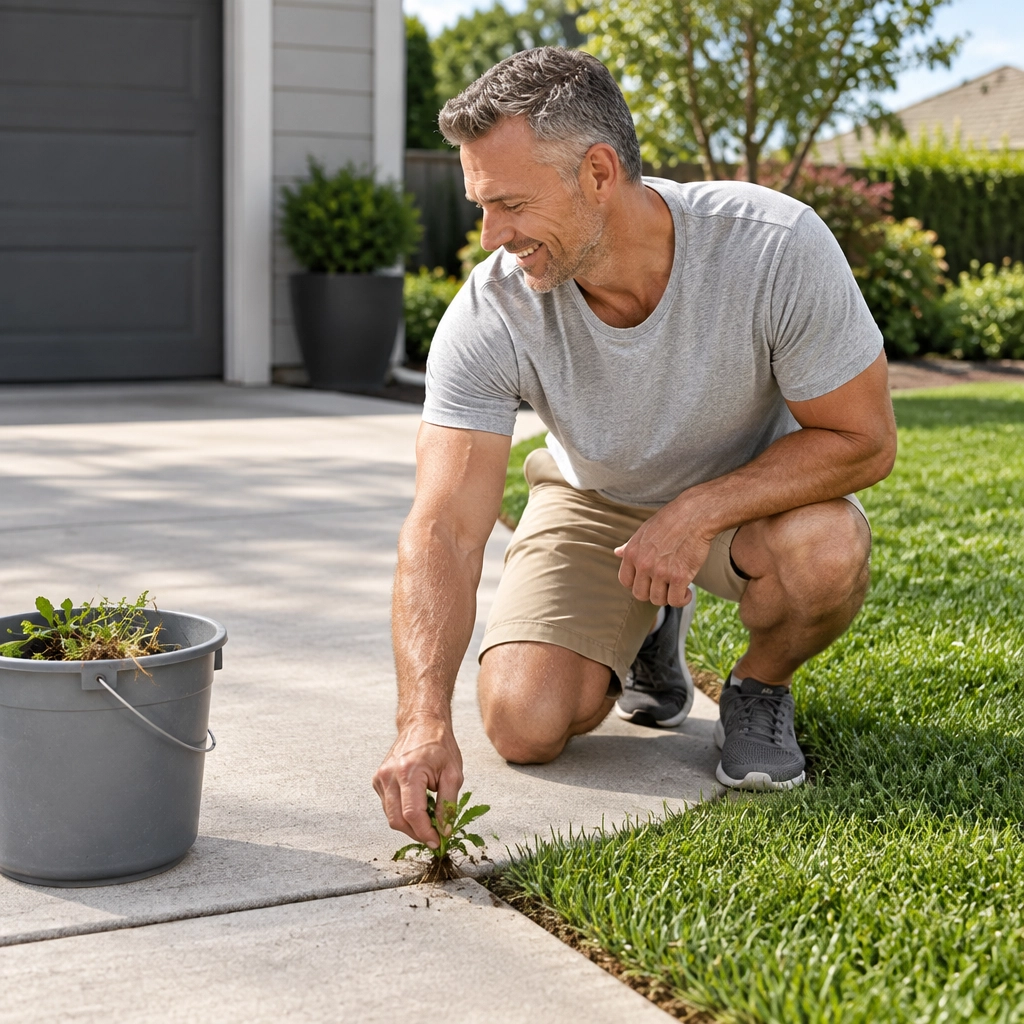
Hand pulling | A few young weeds in accessible joints | No chemical exposure and immediate removal | Roots can break, and larger infestations take time |
Boiling water | Small weeds isolated from desirable plants | Simple contact treatment with no mixing | It can injure nearby turf, soil organisms, and ornamental roots |
Mulching | Open soil beside patios, fences, or beds | Reduces light and suppresses new weed growth | It does not belong in every driveway crack and requires upkeep |
Taller mowing height | Preventive lawn management near hardscape | Helps turf shade soil and compete with weeds | It does not remove weeds already growing in concrete joints |
For most homeowners, the strongest plan combines methods instead of relying on one. Pull isolated weeds, use a carefully directed nonselective treatment for persistent cracks, mulch exposed soil near the patio, and maintain a healthy lawn edge.
4. What Separates Good From Great
A good herbicide kills weeds. A great application controls the entire risk profile from mixing through cleanup.
Accurate Label Match
The product must be registered for the intended use, and the application must follow the label. EPA-registered products are legal to use only according to their labeling. Using a product on an unlisted surface, mixing it at an unapproved rate, or applying it in a prohibited way is off-label use, and off-label use is illegal.
Read the sections covering application sites, weeds controlled, mixing, maximum rates, rainfast timing, reentry, storage, and disposal. If the label does not clearly support your driveway, patio, or crack treatment, do not improvise.
Targeted Coverage
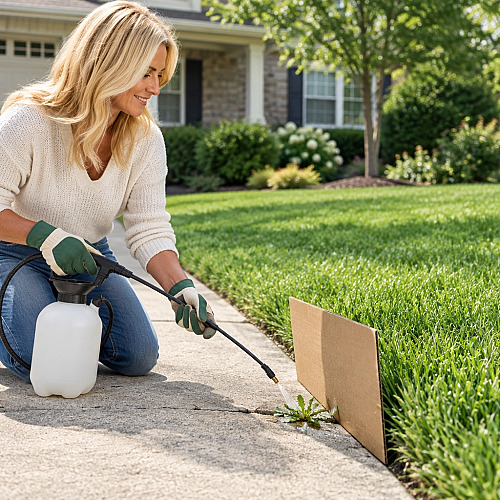
Spray the weed until the foliage is thoroughly wet, not until the hardscape is dripping. A coarse stream or low-drift spray directed at the crack gives you far more control than a fine mist drifting across the lawn.
Use cardboard as a temporary shield near grass, flowers, and shrubs. If desirable plants are accidentally sprayed, rinse them immediately with clean water when the label permits that response.
Calm Weather
Never treat on a windy day. Even a small amount of drift can land on grass blades, flowering plants, or young shoots, and nonselective herbicides do not distinguish between a weed and a prized landscape plant.
Calm does not mean humid, stormy, or rain-soaked. Choose a dry period with enough time for the product to meet its rainfast requirement, and avoid conditions that create runoff from the driveway into the lawn or drainage system.
Water Protection
Keep herbicide away from storm drains, gutters, drainage ditches, ponds, streams, and other surface water. Do not spray directly into a drain or allow puddles to flow off the treatment area.
If rain is forecast, follow the product's stated rainfast time and any longer environmental precaution on the label. Current Roundup Super Concentrate guidance says rain or watering 30 minutes after application will not wash away effectiveness, while also advising users to avoid application when rain is expected during the next 24 hours to help prevent runoff.
Safe Reentry
Keep people and pets off treated areas until the spray has completely dried, or longer if the label requires it. Drying is not a shortcut around other restrictions, including replanting intervals, harvest intervals, and protective equipment requirements.
Plan the treatment when children, pets, and visitors will not cross the driveway or patio. A simple temporary barrier and a clear drying window make compliance much easier.
5. Use A Sprayer That Improves Control
A manual pump sprayer gives you more control than a broad hose-end application when the weeds are concentrated in cracks. The Chapin 20006 SureSpray 3-Gallon Pump Sprayer has a translucent tank, funnel-top opening, adjustable nozzle, and anti-clog design.
The three-gallon size suits larger driveways, but it can be more weight than you need for a few patio joints. For small jobs, fill only the amount of solution required by the label and your measured treatment area. Less leftover spray means less storage, less waste, and less temptation to apply extra product.
Keep a sprayer dedicated to herbicide work. Do not use the same tank for watering edible plants or applying fertilizer unless the manufacturer and product labels support thorough decontamination. After use, rinse the tank and components according to the label, and apply rinse water only where the label permits.
6. Apply The Hardscape Plan
1. Inspect
Walk the driveway and patio before mixing anything. Identify cracks, expansion joints, paver gaps, gravel edges, and areas where grass approaches the treatment zone.
Mark storm drains and note slopes that could carry spray or rainwater away from the target. If a drain is too close or runoff cannot be controlled, hand pull instead.
2. Remove Excess Growth
Pull or trim tall weeds first when practical, but leave enough actively growing foliage for a systemic herbicide to contact. Removing every leaf before treatment can reduce the product's ability to move through the plant.
Bag seed heads and dispose of them rather than leaving mature weeds on the surface. This reduces reseeding and makes the follow-up treatment more efficient.
3. Mix Precisely
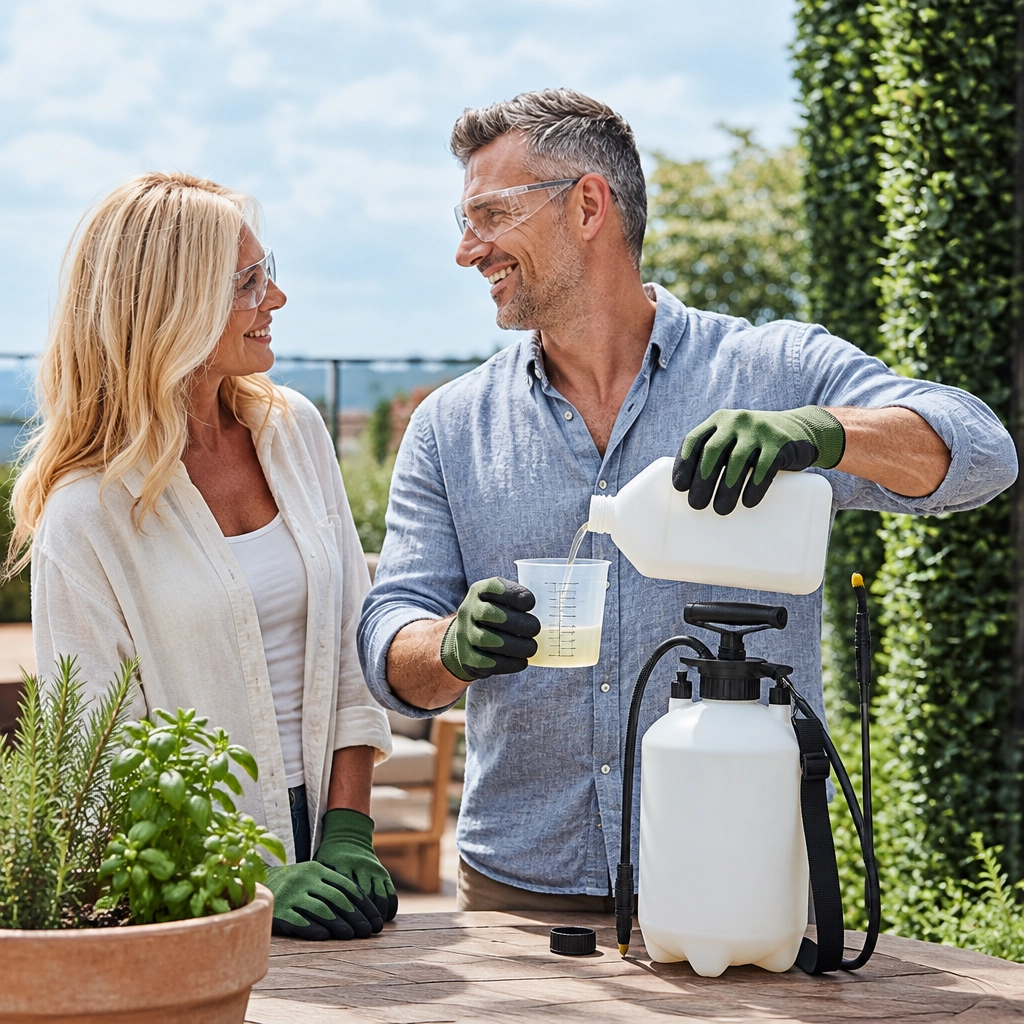
Wear the protective equipment listed on the label. Add water and concentrate in the order and quantities directed by the product label, use a calibrated measuring tool, and never estimate with a kitchen utensil.
Do not exceed the labeled rate. More concentrate can increase plant injury, runoff risk, and legal exposure without improving results.
4. Spot-Treat
Use a coarse spray and keep the wand close to the target. Treat only actively growing weeds on the hardscape, and stop when the foliage is wet rather than creating runoff.
Do not broadcast across the driveway edge, lawn, or landscape beds. If the grass is too close for confident targeting, choose hand pulling or shield the turf before spraying.
5. Wait And Recheck
Visible yellowing can take several days, and complete control can take longer depending on the weed, temperature, and product. Do not immediately reapply because the plant still looks green.
Follow the label's repeat-application interval and maximum seasonal rate. Recheck the area after the required waiting period, then treat only surviving growth.
7. Build Prevention Into The Routine
Chemical control works best when it is part of a maintenance system. Sweep soil and organic debris from patio joints, repair wide cracks where possible, and pull new seedlings while they are small.
Mulch exposed soil next to the patio or driveway to block light and reduce germination. Keep mulch away from surfaces where it can wash into drains, and refresh thin areas before weeds establish deep roots.
Your lawn also helps protect itself. Mow at the upper end of the recommended height for your grass type, avoid scalping along the driveway edge, and maintain consistent moisture. Taller, denser turf shades soil and competes better with weeds than stressed, closely cut grass.
Boiling water can handle a few isolated weeds, but use it only where heat will not reach grass, ornamental roots, or people. Hand pulling remains the lowest-risk option when weeds are sparse and accessible.
8. Final Verdict
The best weed killer for driveways is not the strongest product you can find. It is the correctly labeled nonselective herbicide applied precisely to hardscape weeds, at the exact mixing rate, in calm and dry conditions, with runoff and drift controlled.
For larger or recurring treatments, a properly labeled Roundup concentrate delivers useful value, while a manual Chapin sprayer improves targeting and reduces waste. For a few weeds, hand pulling is often faster and safer. Keep lawn treatments separate, protect storm drains, respect drying and rainfast timing, and let the label make the final call.
Safety and Legal Disclaimer: This article is for general educational purposes and is not a substitute for the product label, EPA registration, state requirements, or professional advice. Herbicides can injure people, pets, desirable plants, and waterways when misused. Always read and follow the complete current label, use required protective equipment, never use a product off-label, and contact a poison control center or medical professional for exposure guidance.






Leave a Comment
Your email address will not be published. Required fields are marked *